

OnePlus recently announced its new “compact” flagship smartphone in India, the OnePlus 13s. It shares many similarities with the OnePlus 13T from China, but it’s not entirely the same device. It has many top-of-the-line specifications such as Snapdragon 8 Elite, 50MP dual rear camera setup, metal build and a lot more.
It’s been about two weeks since I’ve been using this device as my primary phone, and here are my initial thoughts on it. Do give it a read to get an idea of what it brings to the table. The full review will probably come by the end of the month.
Design and Build
The OnePlus 13s has a nice build, which looks very inspired by the iPhones. Heck, some of my friends even got confused the OnePlus 13s as an iPhone.
It has a boxy design with a flat display and a flat frame. There is Corning Gorilla Glass 7i protection on the front as well. The frame is made up of metal and has polished edges to give it a premium in-hand feel. The rear panel is also made up of glass, and its protection is undisclosed. However, it comes with a matte texture which feels nice to hold.

I don’t have any complaints with the build and design part of the device. It has a square-shaped camera island that houses two camera lenses, an LED light and an IR Blaster. The design looks very minimal and eye-catching. I would even go as far as to say that it looks better than their own OnePlus 13.
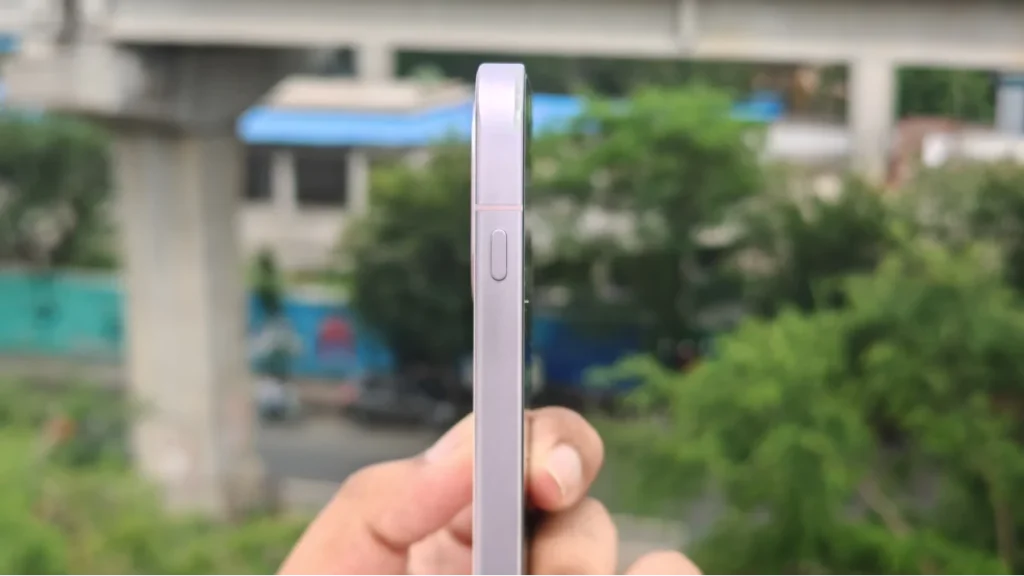
As for the buttons’ placement, the volume controllers and the power on/off button are housed on the right-hand side frame of the gadget, whereas on the left-hand side, we get a new “Plus Key” that replaces the iconic Alert Slider (more on this in my full review). The microphone, speaker grill, SIM tray and USB port are located on the bottom frame, whereas the top one is nearly empty with only a microphone hole.
You also get a nice color-matched soft silicone case inside the box, which is like a cherry on top.
Display
The OnePlus 13s brings a 6.32-inch ProXDR LTPO OLED display with FHD+ pixel resolution. It has a pixel density of 460 PPI and supports HDR 10+, 100% DCI P3 color gamut and Dolby Vision. It can switch from 1Hz to 120Hz depending on the use case. The display is rated 800-nits of normal brightness and 1600-nits of HBM or High Brightness mode.

HDR support is present on YouTube and Netflix as well. The display is no doubt one of the best parts of the gadget. It has nice colors, the sharpness is also good, and it gets bright enough for outdoor usage. However, the HDR or Dolby Vision playback seems to be a little underoptimized for the moment. I’ll wait until the full review to see if the brand pushes any updates to fix this.
Cameras
Cameras are one of the most controversial parts of the OnePlus 13s. It houses a dual rear camera setup with a 50-megapixel LYT-700 main sensor and a 50-megapixel JN5 2X telephoto lens. The main lens has an equivalent focal length of 24mm, whereas the telephoto has that of 49mm. Yes, there is no ultra-wide camera sensor.
On the front, we have a 32-megapixel 21mm selfie camera. And do not forget that this is an auto-focus supported lens, which is rare to get on smartphones.

The device can shoot up to 4K 60FPS videos from both the rear lenses. It can shoot in Dolby Vision HDR as well. On the front, it can shoot in 4K@30FPS, 1080P@30FPS and 720@30FPS.

The lack of an ultra-wide lens and a proper long-range zoom telephoto eliminates it as a choice for someone looking for a camera-oriented smartphone. However, the images with the current setup come out to be fairly good. The telephoto, despite being 2X and without OIS, can do really well in long-range zoom performance. The selfies are probably the best part of the camera system of the OnePlus 13s. However, it’s not all blue, I will talk more about it in my full review dropping soon.
Performance, Battery & Software
The OnePlus 13s packs the Snapdragon 8 Elite chipset. It comes in two variants: 12GB + 256GB and 12GB + 512GB. It has LPDDR5X RAM and UFS 4.0 storage. Performance and heating have always been a major concern for a compact device, but that’s not the case here.
The device can handle everything with ease. You can do heavy gaming, editing, and video shooting, and it will still run as smoothly. And to my surprise, it does not overheat while gaming and multitasking.
Coming down to the battery, it packs a 5850mAh single-cell graphite battery with 80W SUPERVOOC charging support that’s bundled in the box. The battery backup is very good. As for the charging, it takes a comparatively longer time to fully charge since it’s a single-cell battery. The charging time depends a lot on the ambient temperature. It was able to charge fully in around 1 hour, most of the time.

As for the software, it packs flagship-grade OxygenOS 15 based on Android 15 right out of the box. And it’s hard to go wrong with OxygenOS. It’s filled with nice animations, features and optimization. The device comes with promised support of up to 4 years of Android upgrades and up to 6 years of security updates.
The Verdict
OnePlus 13s looks like a very promising “compact” device until now. The gorgeous design, display, performance and even cameras, it has got every basic thing right.
But wait for my full review, where I’ll talk about the device in detail and share my experience and results of thoroughly testing it out.
Check out my other articles:
- OnePlus 13s is in for the review: a new compact flagship in the town!
- CMF Phone 2 Pro Review: Really a ‘Pro’ in Its Segment?
- CMF Phone 2 Pro – Top Tips & Tricks You Need to Know
- GCam on the Honor 200 Pro: We Tested It – See the Results!
- CMF Phone 2 Pro Camera Review: It’s Not What You Are Expecting
- How to Turn Ghibli-Style Images into Magical Animated Videos

